Title IX Team Training

On This Page
Overview
Enacted in 1972, Title IX is a Federal civil-rights law that protects everyone from being discriminated against on the basis of sex in educational programs and activities.
Although Title IX has improved educational access for millions of students, sexual harassment continues to be a widespread problem. In May of 2020, the U.S. Department of Education (DOE) updated its guidelines for how schools must respond to sexual-harassment claims. The guidelines, which took effect on August 14, 2020, apply to all types of sexual harassment, including:
- Student against student
- Student against school employee
- School employee against school employee
- School employee against student
One of the new guideline’s most important changes is that all employees, without delay, must report possible acts of sexual harassment to a Title IX coordinator.
Objectives
Objectives
This course will:
- Define sexual harassment;
- Explain schools’ obligations with regard sexual-harassment claims under Title IX; and
- Outline Title IX’s investigative procedures.
The chapters of this course are:
- Sexual Harassment
- School Obligations under Title IX
- Title IX Grievance Process

Chapter 1: Sexual Harassment
Chapter 1
Sexual Harassment
Topics in this chapter include:
- Definitions
- “On the Basis of Sex” Standard
- Quid Pro Quo Harassment
- “Severe, Pervasive and Objectiably Offensive” Standard
- Offensive Behavior
- “Reasonable Person” Standard
- “Equal Access” Standard
- Sexual Offenses
- Speaking with Victims of Sexual Offenses
Definitions
Definitions
Parties involved in Title IX proceedings include complainants and respondents:
- A complainant is an individual alleged to be the victim of conduct that could constitute sexual harassment.
- A respondent is an individual reported to be the perpetrator of conduct that could constitute sexual harassment.
Complainants and respondents can be students or school employees.
Prohibited by Title IX, sexual harassment is a form of sex discrimination. It encompasses three prongs of misconduct on the basis of sex:
- Quid pro quo harassment occurs when a school employee conditions the provision of an aid, benefit or service on the student’s participation in unwelcome sexual conduct.
- Unwelcome conduct is behavior a reasonable person would find so “severe, pervasive and objectively offensive” that it effectively denies someone equal access to education.
- Sexual offenses include assault, dating violence, domestic violence and stalking, as defined by the Clery Act and as amended by the Violence Against Women’s Act (VAWA).

On the Basis of Sex Standard
“On the Basis of Sex” Standard
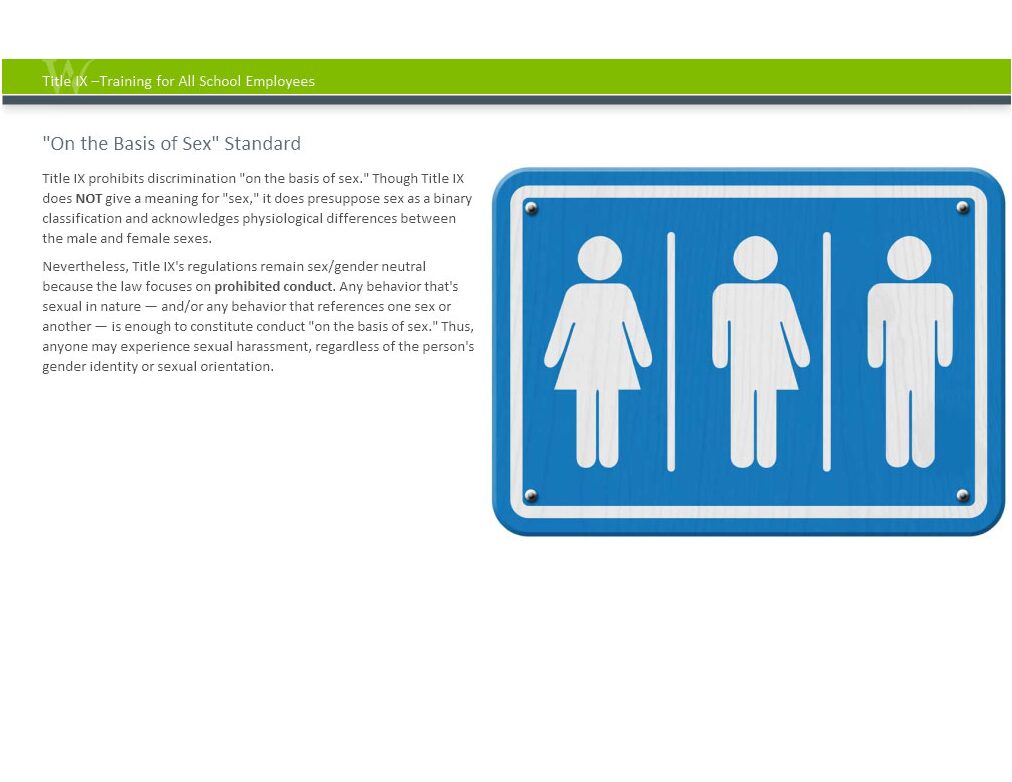
Title IX prohibits discrimination “on the basis of sex.” Though Title IX does NOT give a meaning for “sex,” it does presuppose sex as a binary classification and acknowledges physiological differences between the male and female sexes.
Nevertheless, Title IX’s regulations remain sex/gender neutral because the law focuses on prohibited conduct. Any behavior that’s sexual in nature — and/or any behavior that references one sex or another — is enough to constitute conduct “on the basis of sex.” Thus, anyone may experience sexual harassment, regardless of the person’s gender identity or sexual orientation.
Quid Pro Quo Harassment
Quid Pro Quo Harassment
Quid pro quo harassment is intended to compel a student to engage in “unwelcome” conduct in order to gain or maintain some type of benefit or favor. It applies to any situation where a teacher, faculty member, coach or other employee holds authority and control over a student.
The term “unwelcome” is subjective. A student who does not reject sexual conduct may seem to consent to it. A lack of rejection doesn’t necessarily mean the student actually welcomed the conduct, however. The student might not speak up s/he wants to:
- Avoid getting in trouble,
- Continue to please the teacher;
- Earn good grades; and/or
- Protect her/his position in a school sport or activity.
Students are largely expected to follow the instructions and directions of an adult in charge. If a school employee inappropriately touches a child (for example, by giving her/him back rubs, by massaging her/his shoulders or by rubbing her/his thighs), the student might feel uncomfortable, but accept the attention. Regardless of whether a student pretends to welcome sexual conduct however, a student’s claim that the conduct is unwelcome is enough to qualify the behavior as unwelcome, for legal purposes.
Quid Pro Quo Harassment, continued
Quid Pro Quo Harassment, continued
Because of the power imbalance that exists in a school employee-student relationship, a single instance of quid pro quo harassment is a violation of Title IX.
Sexual conduct between a teacher and student that is consensual and welcomed by the student might not meet the Title IX quid pro quo harassment standard. However, underage students cannot legally consent to sexual activity with an adult; therefore, such conduct may meet Title IX’s sexual-assault standard, which covers statutory rape.

Severe, Pervasive and Objectiably Offensive Standard
“Severe, Pervasive and Objectiably Offensive” Standard
When a school is considering whether conduct is “severe, pervasive and objectiably offensive,” how does it know that the conduct is also unwelcome? It’s not always clear. As such, the school may look to other factors when making that determination, including the involved parties’ ages, disability statuses, sex, etc.
That said, a school cannot consider the intent of the accused or the complainant’s response. It’s not up to a complainant to prove the severity of the unwelcome conduct; a complainant need only describe what occurred. From there, the school must consider whether the conduct was severe from the perspective of a reasonable person.
Offensive Behavior
Offensive Behavior
As younger students develop social skills and learn to interact with others, they are likely to act in ways unacceptable to adults. Similarly, as older students engage in the robust exchange of ideas, opinions and beliefs, they test boundaries and fail to consider how their conduct is perceived.
These types of offensive behaviors do not automatically qualify as actionable under Title IX. In fact, a school’s Title IX enforcement should never interfere with free speech or academic freedom. However, a school should respond to verbal conduct if and when it’s so serious that it loses First Amendment protection because it denies a student equal access to educational benefits.
Just because an offensive, crude, insulting or demeaning remark doesn’t legally qualify as sexual harassment doesn’t mean the school should ignore it. The behavior may very well violate the district’s code of conduct.
Reasonable Person Standard
“Reasonable Person” Standard
A reasonable person standard is used to determine if unwelcome conduct is so severe, pervasive and objectively offensive that it effectively denies a person equal access to education. To evaluate an incident from the perspective of a “reasonable person,” you must consider the ages, abilities and relative positions of authority of the individuals involved.

Equal Access Standard
“Equal Access” Standard
Equal access is determined by considering whether a reasonable person in the complainant’s position would be effectively denied equal access to education, when compared to a similarly situated person who was not subject to the conduct.
No specific type of reaction is necessary to conclude that a person has been denied “equal access.” That said, common indicators of unequal educational access due to sexual harassment include, but are not limited to:
- A complainant skipping class or skipping school to avoid a respondent
- A complainant’s declining grade point average (GPA)
- A complainant having difficulty concentrating in class
Under Title VII, workplace sexual harassment need only be severe or pervasive to be actionable. As previously explained in this course, Title IX’s definition of sexual harassment is more restrictive. Should an incident at your school qualify as sexual harassment under both Title VII and Title IX, your employer must meet the obligations established by both laws.
Sexual Offenses
Sexual Offenses
The third prong of sexual harassment includes acts of forcible and nonforcible sex offenses. These acts comprise:
- Sexual assault, which encompasses:
- Rape — The penetration, no matter how slight, of the vagina or anus with any body part or object, or oral penetration by a sex organ of another person, without the consent of the victim.
- Fondling — The touching of the private body parts of another person for the purpose of sexual gratification, without the consent of the victim. This includes instances where the victim is incapable of giving consent because of her/his age or because of temporary or permanent mental incapacity. It’s important to distinguish fondling from unwanted touching that has no sexualized intent or purpose. For example, inadvertent contact with a person’s buttocks in a crowd does not qualify as sexual harassment under Title IX.
- Incest — Sexual intercourse between persons who are related to each other within the degrees wherein marriage is prohibited by law.
- Statutory rape — Sexual intercourse with a person who is under the statutory age of consent.
Whether an act is considered sexual assault often hinges upon consent. Under Title IX, a school must determine what qualifies as “consent.” However, generally speaking, consent is defined as the voluntary agreement to engage in a specific sexual activity.
Sexual Offenses, continued
Sexual Offenses, continued
- Dating violence — Violence perpetrated by someone who has been in a romantic or intimate relationship with the victim.
- Domestic violence — A felony or misdemeanor crime of violence committed by the victim’s current or former spouse, the victim’s current or former cohabitant, a person similarly situated under domestic or family violence law, or anyone else protected under domestic- or family-violence law.
- Stalking — Behavior in which a person repeatedly engages in conduct directed at a specific person that places that person in reasonable fear for her/his safety or for the safety of others, or that creates substantial emotional distress. Stalking need not always be “on the basis of sex.” For example, a student may stalk an athlete due to her/his popularity, rather than because of her/his sex.
Sexual offenses inherently create the kind of serious, sex-based impediment to equal access to education that Title IX is designed to prohibit. In fact, a single sexual offense is actionable under Title IX. The “severity, pervasiveness and objective offensiveness” standard and the “denial of equal access” standard do not apply.
Speaking with Victims of Sexual Offenses
Speaking with Victims of Sexual Offenses
A sexual offense can leave a victim feeling powerless. Without a safe, confidential place to go, s/he may not report the incident. Often, a victim must feel like s/he is supported before s/he is willing to file a formal complaint and cooperate throughout an investigation.
The first person to whom a victim talks plays a critical role. This person should understand the dynamics of sexual violence and harassment.
Trauma-sensitive practices emphasize the physical and emotional safety survivors need to reestablish a sense of control and to heal. New research has found that the trauma associated with sexual assault can interfere with parts of the brain that control memory. As a result, a victim may have impaired verbal skills, short-term memory loss, memory fragmentation and delayed recall. This can make it challenging for a victim to explain what occurred.
The National Center on Safe and Supportive Learning Environments has developed trauma-informed care training materials. Although these materials were developed for healthcare staff, school employees can also benefit from them.

Speaking with Victims of Sexual Offenses, continued
Speaking with Victims of Sexual Offenses, continued
If a student discloses a sexual offense to you, listen attentively. Ask fact-based, open-ended questions about the situation. Let the student know you believe her/him and that the abuse is not her/his fault. Your goals should be to:
- Support the student; and
- Gather as much information as the student is willing to share so that you can report the incident.
Victims of sexual offenses should be told their confidentiality is protected, by law. Such protection is critical for creating a climate where victims feel safe coming forward.
However, this does not mean that victims’ confidentiality can be guaranteed. School employees should inform victims up front that, depending on the allegations, their information could be shared with the Title IX coordinator, with Child Protective Services (in cases of abuse) and/or with law enforcement.
Chapter 2: School Obligations under Title IX
Chapter 2
School Obligations under Title IX
Topics in this chapter include:
- Notice
- Mandated Reporting
- Educational Programs and Activities
- Mandatory Response
- Supportive Measures
Notice
Notice
A school is legally obligated to respond to any possible sexual harassment about which a school employee has notice. Notice can come from anyone, by any means, at any time. For example:
- An employee might personally observe sexual harassment.
- An employee might hear about about a sexual-harassment incident from the victim, a student, a parent, a bystander or an anonymous source.
- An employee might receive a formal, written complaint.
Any employee who has received notice of alleged sexual harassment must report the incident to the school’s Title IX coordinator. Even if you have doubts about the alleged incident’s validity, you should report it; always err on the side of caution.
A Title IX coordinator will then investigate the situation and dismiss any allegations that don’t qualify as sexual harassment under Title IX. Reports can be made to a Title IX coordinator in person, by mail, by telephone, by e-mail or by any other means. Reports can be made at any time, including outside of school hours.
Mandated Reporting
Mandated Reporting
In addition to violating Title IX, acts of sexual harassment committed by adults against children may also violate criminal law.
All 50 states have mandatory-reporting laws that require school employees to report suspected child abuse to Child Protective Services and/or to a law-enforcement agency. In fact, in many states, mandatory reporters are subject to criminal charges if they fail to report suspected child abuse.
View your state’s mandated-reporting requirements.
Mandatory reporters do not meet their mandatory-reporting obligation by filing a Title IX report with the school.

Educational Programs and Activities
Educational Programs and Activities
Schools must respond to possible acts of sexual harassment that occur during any academic, educational or extra-curricular program or activity. This holds true regardless of whether the school-sponsored activity or program occurs in a school building, on school grounds, on a school bus or off-site.
Furthermore, Title IX regulations do not distinguish between sexual harassment that occurs in-person and sexual harassment that occurs online. “Program or activity” encompass all school operations, including computer and internet networks, digital platforms, and computer hardware or software owned or operated by the school. Sexual harassment can also be perpetrated by a student using a personal device during class time or during an activity where the school exercises substantial control.
Sexual misconduct perpetrated by a school employee on private property may likewise qualify as harassment. Consider a scenario in which a teacher visits a student’s home on the premise of giving a student a book, but the teacher instigates sexual activity. Even though the incident occurs away from school, because the sexual misconduct undermines the basic purpose of the educational system, the teacher’s actions may constitute sexual harassment.
Title IX applies to all persons located in the United States, regardless of their citizenship status or legal residency. However, the law does not apply to school-sponsored study-abroad programs outside U.S. borders.
Mandatory Response
Mandatory Response
For every sexual-harassment allegation, there are mandatory steps schools must take, regardless of whether the conduct was intentional or unintentional, and regardless of whether the school has enough facts to determine whether the harassment definitively occurred.
Upon receiving a report of sexual harassment, the school’s Title IX Coordinator must promptly contact the complainant to discuss:
- What supportive measures are available for the victim;
- The complainant’s wishes with respect to the available supportive measures; and
- The process for filing a formal complaint.
A school must treat an alleged victim as a complainant, even if someone else actually reported the alleged harassment.
Supportive Measures
Supportive Measures
A school must offer supportive measures to every complainant — even the harassment is only alleged and an investigation does not occur.
Supportive measures are individualized services designed to restore or preserve equal access to education, protect student and employee safety, and deter sexual harassment. Supportive measures should be offered that are age-appropriate, that reflect common sense, and that consider the specific and unique needs of the complainant. The measures must also be non-disciplinary, non-punitive and tailored to fit the situation.
Title IX proceedings are often inherently adversarial. An adversarial process can take an emotional toll on both the complainant and the respondent. A school may opt to offer supportive measures to the respondent as well, but it’s not required to do so.
Supportive Measures, continued
Supportive Measures, continued
Examples of supportive measures include, but are not limited to:
- Offering the complainant a different seating assignment
- Allowing the complainant to take a leave of absence
- Allowing the complainant excused absences so that s/he can heal from trauma
- Allowing the complainant to retake an examination
- Providing the complainant post-traumatic stress-disorder (PTSD) counseling
- Allowing the complainant to withdraw from a class without consequence
- Allowing the complainant to retake a class
- Extending assignment deadlines for the complainant
- Modifying the complainant’s class or work schedules
- Restricting contact between the respondent and the complainant
- Improved monitoring of the situation
To summarize:
- Schools must offer supportive measures to every complainant.
- A complainant does not have to file a formal complaint to receive supportive measures.
- A complainant can decline the supportive measures that are offered.
Chapter 3: Title IX Grievance Process
Chapter 3
Title IX Grievance Process
Topics in this chapter include:
- Formal Complaints
- Dismissal of Formal Complaints
- Informal Resolutions
- Investigations
- Due Process
- Presumption of Non-Responsibility
- Advisor of Choice
- Title IX Personnel
- Evidence
- Inadmissible Evidence
- Evidentiary Standard
- Live Hearings
- Remedies and Sanctions
- The Right to Appeal
- Retaliation

Formal Complaints
Formal Complaints
A school must begin to investigate a sexual-harassment allegation as soon as a complainant files a formal complaint. Signed by the complainant or the Title IX coordinator, a formal complaint is a document requesting that the school investigate the allegation.
Should a complainant choose not to sign a formal complaint, the respondent has the right to refuse to participate in the grievance process. Complainants must never be coerced or threatened into signing, but they must still be offered supportive measures.
The only person who can file a formal complaint other than a complainant is a Title IX coordinator. There may be situations in which a complainant chooses not to file a formal complaint, but safety concerns may lead the Title IX coordinator to file one anyway. For example, a Title IX coordinator may choose to file a complaint if another person has alleged harassment against the same respondent.
Once a formal complaint has been filed, the school must send both the complainant and the respondent written notice. This notice must describe the allegations and explain the grievance process that will be used to investigate and adjudicate the complaint.
Other school administrators may report alleged sexual harassment to the Title IX coordinator and request that an investigation take place. However, the final decision to initiate the grievance process is left to the Title IX coordinator.
Dismissal of Formal Complaints
Dismissal of Formal Complaints
There are two ways in which a formal complaint might be dismissed. A mandatory dismissal occurs if:
- A formal complaint doesn’t describe conduct that meets Title IX’s definition of sexual harassment;
- A formal complaint alleges sexual harassment that did not occur as part of a school’s educational program or activity; or
- A formal complaint describes sexual conduct that did not occur against a person in the United States.
A discretionary dismissal may occur if:
- The complainant notifies the Title IX coordinator, in writing, that s/he wishes to withdraw the formal complaint;
- The complainant refuses to participate in the grievance process, but hasn’t sent written notice stating their desire to withdraw the formal complaint;
- Specific circumstances prevent the Title IX coordinator from gathering enough evidence to determine responsibility; or
- The respondent is not under the authority of the school. For example:
- The respondent could be a non-student or a non-employee who sexually harassed a complainant at a school event open to the public.
- The respondent could no longer be enrolled in the school or employed by the school.
A dismissal of a formal complaint is for Title IX purposes only. A school may still address sexual-harassment allegations under its own code of conduct.
Informal Resolutions
Informal Resolutions
Schools may choose to offer an informal-resolution process — e.g., mediation, arbitration or restorative justice — as an alternative to investigating and adjudicating a formal complaint. Informal-resolution processes may only be offered as an option after a formal complaint has been filed. (Schools are not required to offer informal-resolution processes of any kind.)
Schools are prohibited from:
- Requiring parties to participate in an informal-resolution process;
- Instructing parties to work things out amongst themselves as a strategy; and/or
- Requiring parties to confront each other or be together in the same room.
Due to an imbalance of power, informal-resolution strategies cannot be offered in formal complaints between school employees and students. However, an informal-resolution process can potentially be used to resolve harassment allegations between two employees.
Prior to a resolution being reached, either party may — at any time — withdraw from the informal-resolution process and resume the official grievance process.
All schools must implement a written, consistent, transparent grievance process.
Investigations
Investigations
If someone is found responsible for sexual harassment, the consequences are serious, regardless of whether the respondent is an employee or a student.
An employee respondent might lose her/his job. And a student respondent might miss out on educational opportunities that could impact her/his future.
Because of the high stakes involved, Title IX personnel must carefully, thoughtfully and reasonably investigate and evaluate each formal complaint. The investigative process involves the following steps:
- An investigator gathers evidence directly related to the allegations.
- Both parties present inculpatory and exculpatory facts, evidence and expert witnesses.
- The investigator summarizes all relevant evidence in an investigative report.
- Both parties are given equal opportunity to review the investigative report.
- Both parties are provided the opportunity to submit a written response about the report to the decision-maker.
- The decision-maker issues a determination of responsibility.
Many of the procedural protections and rights afforded to complainants and respondents are described in the remainder of this course.
Due Process
Due Process
The Title IX sexual-harassment grievance process contains procedural requirements, rights and protections consistent with constitutional due process.
In public schools, due process is a practical matter that requires — at minimum — both parties being afforded equal opportunity to share their views about the allegation. Employees and students receive the same benefits and due-process protections.

Presumption of Non-Responsibility
Presumption of Non-Responsibility
Respondents are presumed not to be responsible for any alleged conduct throughout the grievance process. Responsibility for the alleged conduct is only determined after the grievance process has concluded.
Rooted in the same principle that underlies the constitutional presumption of innocence, the presumption of non-responsibility means that:
- Schools should not view complaints with skepticism.
- Schools should not assume respondents are truthful and credible.
- Schools must treat respondents fairly.
- Schools cannot discipline respondents until the grievance process has concluded.
Although a respondent is presumed to be non-responsible for any alleged conduct, emergency measures can be taken to remove a complainant from school if an immediate safety threat exists.

Advisor of Choice
Advisor of Choice
Each party can choose her/his own advisor. An advisor:
- Provides support, advice and assistance throughout the grievance process.
- Can be anyone the party trusts — e.g., a parent, a guardian, a family member, a friend, a teacher, an advocacy-organization volunteer, an attorney, etc.
An advisor does not need to have specialized training because the grievance process doesn’t require detailed legal knowledge.

Title IX Personnel
Title IX Personnel
The grievance process requires the collaboration of multiple Title IX personnel:
- A Title IX coordinator reports sexual misconduct; contacts the complainant to discuss supportive measures and explain the grievance process; and coordinates the delivery of supportive measures and remedies to the complainant.
- An investigator collects evidence related to the allegations; interviews both parties and any witnesses; and summarizes gathered the information in an investigative report. (A Title IX coordinator can serve as the investigator.)
- A decision-maker evaluates relevant evidence; issues a written determination stating whether the respondent is responsible for the alleged sexual harassment and explaining the rationale behind that decision; and assigns any necessary remedies and sanctions.

Title IX Personnel, continued
Title IX Personnel, continued
A school may choose to have a single decision-maker, or it may choose to have multiple decision-makers. Although the Title IX coordinator and the investigator cannot serve as decision-maker, they are allowed to make recommendations regarding responsibility.
Despite their differing roles and responsibilities, all Title IX personnel must:
- Interact with the complainant and respondent impartially and without bias;
- Have no conflicts-of-interest with either party;
- Refrain from making assumptions about either party’s credibility or truthfulness; and
- Never pass judgment about the facts of an incident until the grievance process concludes.

Evidence
Evidence
A fair grievance process requires that both parties have every opportunity to participate equally, fully and meaningfully in the investigation. Both parties may:
- Gather and present inculpatory and exculpatory evidence;
- Present facts and expert witnesses;
- Submit questions to other parties and witnesses;
- Review the evidence gathered; and
- Respond to the investigative report.
The burden of proof — and the burden of collecting impartial evidence sufficient to reach a determination regarding responsibility — rests on the school. Schools cannot shift that burden to a complainant or a respondent.
In addition, schools cannot restrict either party from discussing the allegations being investigated. (In other words, there can be no gag orders imposed.) To do so would restrict a party’s ability to gather evidence.

Inadmissible Evidence
Inadmissible Evidence
Questions and evidence about a complainant’s prior sexual behavior are deemed irrelevant, unless:
- The evidence is offered to prove that someone other than the respondent committed the alleged misconduct; or
- The evidence is offered to prove consent. (This mirrors rape-shield protections.)
In addition, a school cannot access, consider, disclose or otherwise use a party’s medical- or psychological-treatment records, unless the school obtains voluntary, written consent to do so. This holds true regardless of whether the school already possesses the treatment records, and regardless of whether the records are relevant.
Title IX regulations do not specifically address the admissibility of hearsay, prior bad acts or character evidence.

Evidentiary Standard
Evidentiary Standard
A school must notify students and employees in advance about which evidentiary standard will be used during its sexual-harassment grievance process. A school can select either:
- A clear and convincing evidence standard; or
- A preponderance of evidence standard.
Once a standard is chosen, a school must use it for every Title IX sexual-harassment complaint, regardless of whether a respondent is a student or an employee.
A clear and convincing evidence standard is a conclusion that a fact is substantially more likely than not to be true. The standard requires sufficient evidence to conclude that the truth of an allegation is highly probable.
A preponderance of evidence standard is a conclusion that a fact is more likely than not to be true. The standard is often described as 51% of the evidence favoring a finding of fault.
When applied in a fair manner, either evidentiary standard will help a school reach a reliable outcome.
Live Hearings
Live Hearings
A postsecondary institution is required to hold a live hearing that allows for cross-examinations. A K-12 school does not need to hold a live hearing, but each party must be allowed to submit written questions for the other party and witnesses to answer.

Remedies and Sanctions
Remedies and Sanctions
The grievance process must describe the possible remedies and disciplinary sanctions a school may assign if a respondent is found responsible for sexual harassment:
- Remedies — A school may provide the complainant remedies designed to restore or preserve her/his equal access to education.
- Sanctions — A school may assign the respondent punitive measures, behavior-modification measures, or some combination thereof. Sanctions assigned to students may be different than those assigned to employees.
Although a school cannot assign sanctions prior to the conclusion of the grievance process, a school can address inappropriate behavior before then. Non-punitive actions designed to intervene quickly and correct inappropriate behavior are not considered sanctions.
Examples of non-punitive actions include, but are not limited to: speaking with a student about her/his inappropriate behavior, referring a student to the office, and/or changing a student’s classroom-seating assignment. These simple classroom disciplinary measures can help maintain order, protect students and modify behavior.
The Right to Appeal
The Right to Appeal
Schools must offer both parties the opportunity to appeal a determination regarding responsibility. There are three bases on which an appeal can be made:
- A procedural irregularity that resulted in the failure to evaluate all relevant evidence objectively.
- New evidence that was not previously available.
- A Title IX official’s bias or conflict of interest, which affected the outcome of the previous grievance process.
The decision-maker for the appeals process cannot be:
- The Title IX coordinator;
- The investigator; or
- The decision-maker who previously determined responsibility.
Retaliation
Retaliation
Title IX regulations expressly prohibit retaliation against anyone involved in a report, investigation, proceeding or hearing. Intimidation, threats, coercion and discrimination are all forbidden.

Reporting Process
Reporting Process
RESPONSE
- Report to Title IX Coordinator
- If child abuse is suspected, comply with state mandatory reporting laws
- Supportive measures, resolution options presented to complainant
- Complainant chooses support only
- Complainant files formal complaint
- Title IX coordinator files complaint
- End of process
INFORMAL
- Informal resolution process
- Agreement reached
- Agreement not reached
- End of process
INVESTIGATION
- Investigation
- Review of evidence
- 10-day response period
- Investigation report
- 10-day follow-up period
- Written determination
- Appeal period
- End of process

End of Section
End of Section
You have completed this section of the course. You must complete all sections and take the test to receive credit for this course.
Click on the next section in the left-hand navigation bar. If you’ve completed all sections, please click “Take Test.”
